
How Is the Climate Changing in 2026, and What Can We Expect from Climate Change, The boy, and Extreme Weather Events?
A clear, well-documented guide on extreme heat, heavy rainfall, public health, and citizen preparedness for Spanish-speaking audiences.
The climate outlook does not point toward a return to normal conditions, but rather toward an intensification of risk. The World Meteorological Organization (WMO) confirmed that 2024 was likely the first calendar year to exceed the pre-industrial level by more than 1.5°C, with a global mean near-surface temperature of approximately 1.55 ± 0.13°C above the 1850–1900 average.
In 2025, the signal remained exceptional: the WMO ranked it among the three warmest years on record, while Copernicus classified it as the third warmest year ever observed. The first months of 2026 have shown no clear reversal of this trend: March 2026 was the fourth warmest March on record, and April 2026 tied as the third warmest April ever recorded.
Official forecasts continue to warn that the risk is increasing. The WMO projects that between 2026 and 2030, the global annual mean temperature could range from 1.3°C to 1.9°C above pre-industrial levels. It also estimates an 86% probability that at least one of those years will surpass 2024 as the warmest year on record, and a 91% probability that at least one year will once again temporarily exceed the 1.5°C threshold.
Adding to this concern is a significant natural climate signal: as of June 2, 2026, the WMO reported an 80% probability that El Niño conditions would develop between June and August, and a probability of around or above 90% that they would persist at least through November.
For Latin America and the Caribbean, the assessment is equally severe. The WMO reported that 2025 was marked by unprecedented heat, persistent droughts, extreme rainfall, and devastating tropical cyclones. In Mexico, the WMO notes that the country has experienced the fastest warming rate in the region, averaging about 0.34°C per decade between 1991 and 2025.
Heat is no longer just an environmental issue. The World Health Organization (WHO) warns that heatstroke is the leading cause of climate-related deaths and that the risk increases significantly for older adults, people with chronic illnesses, outdoor workers, and households with poor ventilation.

Talking about the weather in 2026 no longer means simply checking whether it will rain tomorrow or whether the afternoon will be hot. It means understanding that the baseline of the climate system has shifted: the oceans are storing more heat, the atmosphere contains more energy and moisture, and extreme events—heat waves, torrential rainfall, prolonged droughts, wildfires, and intense cyclones—are becoming more likely and more costly for public health, infrastructure, and the economy. The WMO and the IPCC agree that the warming of the atmosphere, oceans, and land due to human influence is unequivocal.
Because no specific region was identified, this draft operates on two scales simultaneously: a global perspective for broad context and a regional/local focus on Latin America and Mexico. This approach aligns well with a Spanish-speaking Latin American audience and allows the discussion to be grounded in operational information from official sources. Editorially, this combination works well because it connects the global conversation on climate change with everyday decisions related to health, preparedness, and risk reduction.
Current Climate Conditions and Outlook
At the global level, the dominant signal remains continued warming. The WMO confirmed that 2024 shattered temperature records and that 2025 remained within the range of historical highs. Its latest updates also project that global temperatures will remain at or near record levels in the coming years.
The development of El Niño conditions in the tropical Pacific adds another layer of risk for 2026 and 2027, as this climate pattern typically raises global average temperatures and alters rainfall and drought patterns across multiple regions.

Latin America and the Caribbean: A Region Already Feeling the Effects
In Latin America and the Caribbean, the World Meteorological Organization (WMO) describes a scenario in which extreme heat, disruptions to the water cycle, ocean warming, and glacier retreat are already affecting public health, agriculture, water security, and coastal areas. Looking ahead, the WMO identifies strong signals of above-normal temperatures across much of southern North America, Central America, and the Caribbean. Precipitation, however, is expected to vary significantly by region. This makes it important to avoid oversimplified messages such as “there will be more rain everywhere” or “everything will become drier,” because the actual pattern is far more uneven.
As a useful local example for a blog targeting Latin American audiences, Mexico already provides a compelling narrative hook. The National Meteorological Service (Servicio Meteorológico Nacional, SMN) reported that the 2026 Atlantic hurricane season officially began on June 1, and on that same day forecasts indicated intense rainfall in southeastern regions alongside maximum temperatures of 40–45°C (104–113°F) across several northern and western states. This contrast between severe rainfall and extreme heat serves as an effective journalistic introduction because it illustrates, in real time, the volatility of the regional climate system.
Scientific Causes and the Role of the boy
The scientific explanation remains fundamentally the same, but the evidence is now stronger and leaves less room for doubt: according to the Intergovernmental Panel on Climate Change (IPCC), current warming is unequivocally attributable to human influence. The IPCC Working Group I states that the atmosphere, ocean, and land have warmed due to human activities, and that rapid and widespread changes are already being observed across the atmosphere, oceans, cryosphere, and biosphere.
The most important driver is the accumulation of greenhouse gases. The WMO reported that the global average concentration of carbon dioxide (CO₂) reached 420.0 parts per million (ppm) in 2023 and increased to 423.9 ppm in 2024, representing an annual rise of 3.5 ppm—the largest increase since modern measurements began in 1957. In the same bulletin, the WMO noted that radiative forcing from long-lived greenhouse gases increased by 51.5% between 1990 and 2023, with CO₂ accounting for approximately 81% of that increase. In other words, the planet is not only warmer; it is also being subjected to stronger forces that continue to drive warming.
El Niño does not replace this explanation—it modifies it. The WMO indicated that the exceptional temperatures recorded in 2023 and 2024 were primarily caused by the ongoing rise in greenhouse gas emissions, combined with the transition from La Niña to El Niño conditions. In 2026, the organization again warns that El Niño is re-emerging and that, although it is a natural and recurring phenomenon, it can intensify heat waves, heavy rainfall, and droughts on top of a climate system already overheated by human activity. Therefore, the most accurate formulation for an article is not “El Niño causes the climate crisis,” but rather “El Niño temporarily exacerbates a climate system already altered by anthropogenic warming.”
Recent Impacts and Extreme Events
Climate change is no longer expressed solely as a laboratory trend; it is now visible through a chain of interconnected impacts. The WMO reported that in 2024, tropical cyclones, floods, droughts, and other hazards generated the highest number of new displacements in the past 16 years, worsened food security crises, and caused substantial economic losses. For 2025, the WMO added that heat waves, wildfires, droughts, cyclones, storms, and floods resulted in thousands of deaths, affected millions of people, and caused billions of dollars in damages.
In Latin America and the Caribbean, 2024 provided particularly clear examples. The Amazon and Pantanal regions experienced rainfall levels between 30% and 40% below normal. In Chile, wildfires caused more than 130 deaths. In Brazil’s Rio Grande do Sul state, flooding resulted in more than 180 fatalities and agricultural losses estimated at around 8.5 billion reais. Hurricane Beryl became the strongest hurricane ever recorded to make landfall in Grenada. Meanwhile, Venezuela lost its last remaining glacier, the Humboldt Glacier. All of this occurred in a region whose average temperature in 2024 was 0.90°C above the 1991–2020 average.

In 2025, the WMO reported new episodes of extreme heat, with temperatures well above 40°C recorded across large areas of North America, Central America, and South America. The organization also documented that Hurricane Melissa became the first Category 5 hurricane on record to make landfall in Jamaica, causing 45 deaths and approximately US$8.8 billion in damages—equivalent to more than 41% of the country’s GDP.
Within the same regional context, the WMO notes that Mexico has experienced the fastest warming rate in Latin America and the Caribbean, averaging around 0.34°C per decade between 1991 and 2025. In 2025, the city of Mexicali reached 52.7°C, setting a new national temperature record. Furthermore, based on data from 17 countries, the organization estimates that approximately 13,000 deaths per year in the region are attributable to heat exposure.
Practical Recommendations for Citizens: Health, Preparedness, and Mitigation
The World Health Organization (WHO) warns that extreme heat is a major public health threat and that heatstroke is the leading cause of weather-related deaths. The organization also emphasizes that exposure to heat has increased significantly and that vulnerability depends not only on age and health status, but also on housing conditions, occupation, income level, and access to cooling spaces.
For a general audience, this section of the article should be highly practical. It is not enough to simply advise people to “stay safe”; readers need clear guidance on what actions to take, when to take them, and who should be monitored most closely.
Key recommendations include staying hydrated throughout the day, even before feeling thirsty; avoiding outdoor activities during the hottest hours, typically between 11 a.m. and 4 p.m.; wearing lightweight, light-colored clothing; and seeking shade or air-conditioned environments whenever possible. Special attention should be given to older adults, infants, pregnant women, people with chronic illnesses, and outdoor workers, as these groups face the highest risk of heat-related illness.
Communities can also improve preparedness by paying attention to official weather warnings, identifying local cooling centers or public shelters, and checking regularly on vulnerable family members and neighbors during heat waves. At the household level, simple measures such as improving ventilation, using blinds or curtains to reduce indoor heat gain, and ensuring access to clean drinking water can significantly reduce health risks.
Longer-term mitigation efforts remain equally important. Reducing greenhouse gas emissions, expanding urban green spaces, protecting forests, improving water management, and investing in climate-resilient infrastructure can help limit future warming and reduce the severity of climate-related impacts. While adaptation measures are essential for protecting communities today, mitigation remains the only way to address the root causes of climate change and reduce risks for future generations.
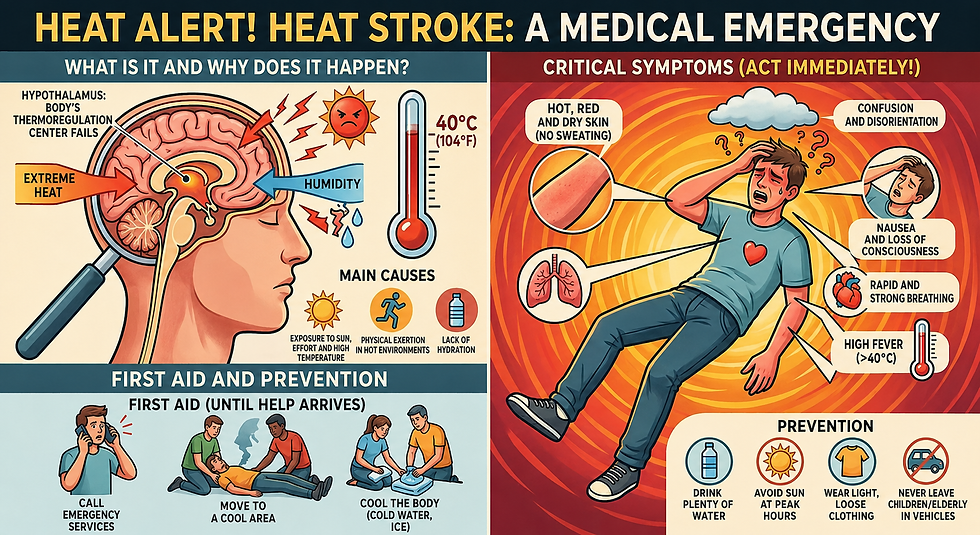
There is a second layer that should be explained clearly: adaptation and mitigation are not the same thing.
Adaptation means reducing immediate harm—staying hydrated, preparing an emergency kit, following official alerts, identifying shelters, and keeping homes cool. Mitigation, on the other hand, means addressing the root cause of the problem: reducing greenhouse gas emissions, improving energy efficiency, cooling cities through shade and better urban design, protecting ecosystems, and expanding early warning systems.
The World Health Organization (WHO) maintains that reducing emissions is essential to limit the impacts of extreme heat, while the World Meteorological Organization (WMO) emphasizes that investments in weather, climate, and early warning services are critical for saving lives and strengthening resilience.
Frequently Asked Questions
Does a single year above 1.5°C mean that the Paris Agreement has already failed?
Not necessarily. The WMO clarifies that temporarily exceeding 1.5°C in a specific year does not automatically mean that the goals of the Paris Agreement have been permanently missed. Those goals are assessed using longer-term trends, typically measured over several decades. However, such exceedances are a serious warning sign because they indicate that the remaining margin of safety is shrinking.
Are El Niño and climate change the same thing?
No. El Niño is a natural phase of the tropical Pacific Ocean-atmosphere system, whereas current climate change is driven primarily by rising greenhouse gas concentrations resulting from human activities. What happens is that El Niño can temporarily intensify heat and alter rainfall patterns on a planet that is already warmer because of anthropogenic warming.
Could 2026 become the hottest year ever recorded?
It is possible, but it cannot currently be stated with certainty for 2026 specifically. The WMO estimates an 86% probability that at least one year between 2026 and 2030 will surpass 2024 as the warmest year on record. Its late-May update also indicates that the emergence of El Niño toward the end of 2026 increases the likelihood that 2027 could set a new global temperature record.
Why are we seeing both more heat waves and more intense rainfall?
Because a warmer planet stores more energy in the atmosphere and oceans, and a warmer atmosphere can hold more water vapor. This contributes to longer and more intense heat waves and, when storms develop, heavier rainfall events. At the same time, regional differences can produce severe droughts in some areas and excessive rainfall in others.
Who is most at risk from extreme heat?
According to the WHO, the most vulnerable groups include older adults, infants and children, people with cardiovascular, respiratory, kidney, or mental health conditions, outdoor workers, athletes, and individuals living in poorly ventilated or low-quality housing. Risks increase further during periods of high humidity, unusually warm nights, and power outages.
What should a truly useful emergency kit contain?
Basic emergency supplies should include water, non-perishable food, personal documents, a first-aid kit, a battery-powered radio, a flashlight, extra batteries, cash, clothing, hygiene items, and essential medications. Mexico’s National Center for Disaster Prevention (CENAPRED) also recommends adapting emergency kits to the needs of infants, older adults, people with disabilities, and pets, while ensuring supplies are sufficient for at least the first 72 hours following an emergency.
Which official sources should be linked to keep this article updated?
The best practice is to link to the national meteorological service relevant to the audience’s country. For articles focused on Mexico, key operational references include the National Meteorological Service (SMN) and CONAGUA. For broader international context, it is also advisable to link to the World Meteorological Organization (WMO) and the WMO World Weather Information Service (WWIS), which compiles official forecasts from thousands of cities worldwide.


Comments